
Shown are a few caterpillars that may be encountered in Southwest Florida, including Naples and surrounding communities. Caterpillars can differ greatly in color, body shape, markings, and the presence of hairs or spines. Some spiny caterpillars can cause painful skin reactions, so an unfamiliar caterpillar should be observed without handling it directly.
Oleander Moth
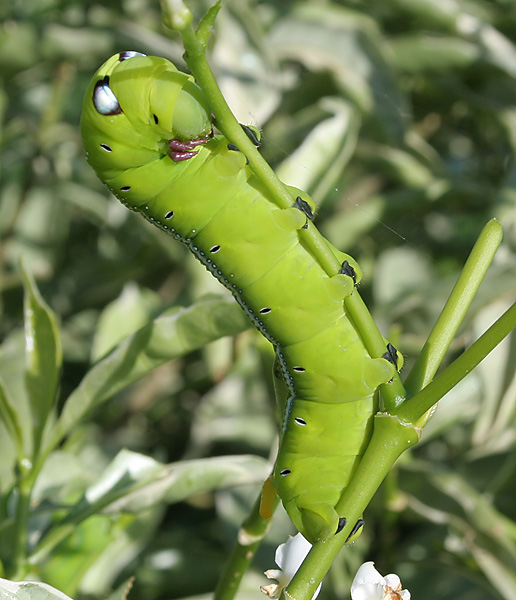
Identification Facts
- Appearance
- The caterpillar shown is predominantly green, with a smooth-looking body and distinct markings that contrast with the surrounding green coloration.
- Body shape
- Its elongated, substantial body differs noticeably from the compact, heavily spined appearance of the saddleback caterpillar shown farther down this page.
- Useful identification clues
- Overall color, body markings, body shape, and the plant on which a caterpillar is found can all provide useful information when narrowing an identification.
- Identification limits
- A photograph or brief observation may not provide enough information for an exact identification. Similar-looking caterpillars can occur on different plants and may change in appearance as they develop.
When trying to identify a green caterpillar, it can be useful to photograph both the caterpillar and the plant where it was found. The host plant can provide identification context that a close photograph of the caterpillar alone does not preserve.
I.O. Moth Caterpillar
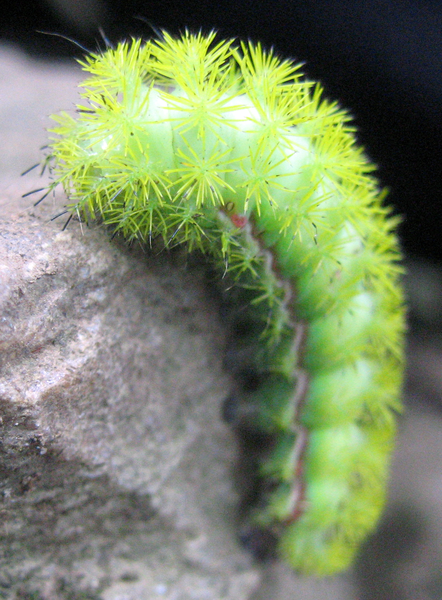
Identification Facts
- Appearance
- I.O. moth caterpillars can have a bright green appearance with conspicuous clusters of spines covering much of the body.
- Spines
- The branching spines are an important identification characteristic. They should also be treated as a reason not to handle the caterpillar with bare hands.
- Color and markings
- Green body coloration and contrasting markings along the sides can provide additional visual clues, particularly when viewed together with the characteristic spines.
- Contact
- The spines can cause a painful stinging or burning skin reaction if they are touched.
- Identification approach
- When an unfamiliar caterpillar is covered with obvious spines, visual observation or photography is safer than touching it to obtain a closer look.
The I.O. moth caterpillar is a good example of why caterpillar identification involves more than matching color. A green caterpillar may initially appear harmless, while the arrangement and structure of its spines provide both an identification clue and important information about avoiding direct contact.
Saddleback Caterpillar
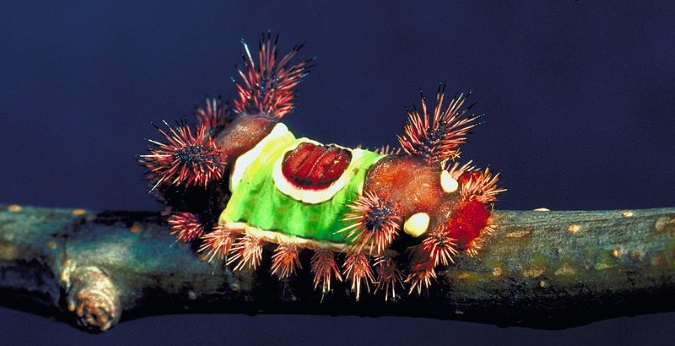
Identification Facts
- Appearance
- The saddleback caterpillar has a distinctive appearance, with a bright green area across the middle of the body surrounding a contrasting brown or reddish marking.
- Saddle-like marking
- The contrasting marking across the back creates the saddle-like appearance responsible for the caterpillar’s common name.
- Spines
- Prominent spines project from the body, including noticeable clusters toward the front and rear.
- Contact
- The spines can cause a painful skin reaction and should not be touched with bare hands.
- Useful identification combination
- The compact body, bright green central area, contrasting saddle-like marking, and conspicuous spines together create a particularly recognizable identification pattern.
The saddleback caterpillar demonstrates why distinctive markings can be more useful than color considered by itself. The green body area is only one clue; the contrasting central marking and arrangement of the spines provide a much more specific visual pattern.
Caterpillar Identification Clues
Caterpillars can change considerably as they develop, and many species share similar colors. Identification is therefore more dependable when several visible characteristics and the surrounding context are considered together.
- Body shape
- Consider whether the caterpillar is slender, robust, flattened, compact, smooth, hairy, or heavily spined.
- Color and markings
- Stripes, spots, contrasting patches, and other patterns can be more informative than the caterpillar’s primary color alone.
- Hairs and spines
- The presence, absence, shape, and arrangement of hairs or spines can provide important identification information. Unfamiliar spiny caterpillars should not be handled directly.
- Host plant
- The plant on which a caterpillar is feeding or resting can provide valuable context because different caterpillars are associated with different host plants.
- Photographs
- A clear photograph showing the entire caterpillar, its markings, and its body structures can preserve details that may be difficult to remember after the encounter.
When possible, photograph an unfamiliar caterpillar without moving or touching it. An additional photograph of the plant and surrounding area can preserve useful context for later identification.
Caterpillar Identification Questions
Are brightly colored caterpillars dangerous to touch?
Color alone does not determine whether a caterpillar can cause a reaction. Some brightly colored caterpillars can be touched without injury, while some spiny caterpillars can cause painful skin reactions. If the caterpillar is unfamiliar, particularly if it has conspicuous hairs or spines, avoiding direct contact is the safer approach.
Can caterpillar spines sting?
Some can. The spines of caterpillars such as the I.O. moth caterpillar and saddleback caterpillar can cause painful skin reactions when touched. Spines should therefore be treated as meaningful structures rather than simply decorative features.
Why is the plant important when identifying a caterpillar?
Many caterpillars feed on particular plants or groups of plants. Knowing where a caterpillar was found can therefore narrow the possibilities. A photograph of the host plant can sometimes provide identification information that is missing from a close-up photograph of the caterpillar.
Can a caterpillar be identified from one photograph?
Sometimes, particularly when it has distinctive markings or structures. In other cases, one photograph may not show enough information. Multiple angles, approximate size, the host plant, location, and visible hairs or spines can all help support a more specific identification.
Should I pick up a caterpillar to get a better photograph?
No. An unfamiliar caterpillar can usually be photographed where it is found. Because some caterpillars have irritating or stinging hairs and spines, handling one simply to obtain a closer view can create an unnecessary exposure.