

Shown are examples of earwigs that may be encountered in Southwest Florida, including Naples and surrounding communities. Earwigs are most easily recognized by the pair of forceps-like appendages at the end of the abdomen. Their elongated bodies, long antennae, and preference for sheltered, moist locations provide additional identification clues.
Earwig Example

Identification Facts
- Body shape
- Earwigs have elongated, somewhat flattened bodies that allow them to move into narrow, sheltered spaces.
- Forceps
- The pair of forceps-like appendages at the end of the abdomen is the most recognizable earwig characteristic. These structures are also called cerci.
- Antennae
- Earwigs have long, segmented antennae extending from the head.
- Color
- Earwigs are commonly brown to dark brown, although coloration and markings can vary.
- Movement
- They generally move by running rather than jumping and may quickly seek cover when their hiding place is disturbed.
The forceps at the rear of the body provide the quickest visual clue when identifying an earwig. Even when color or size varies, the combination of an elongated body, long antennae, and paired abdominal forceps creates a distinctive overall appearance.
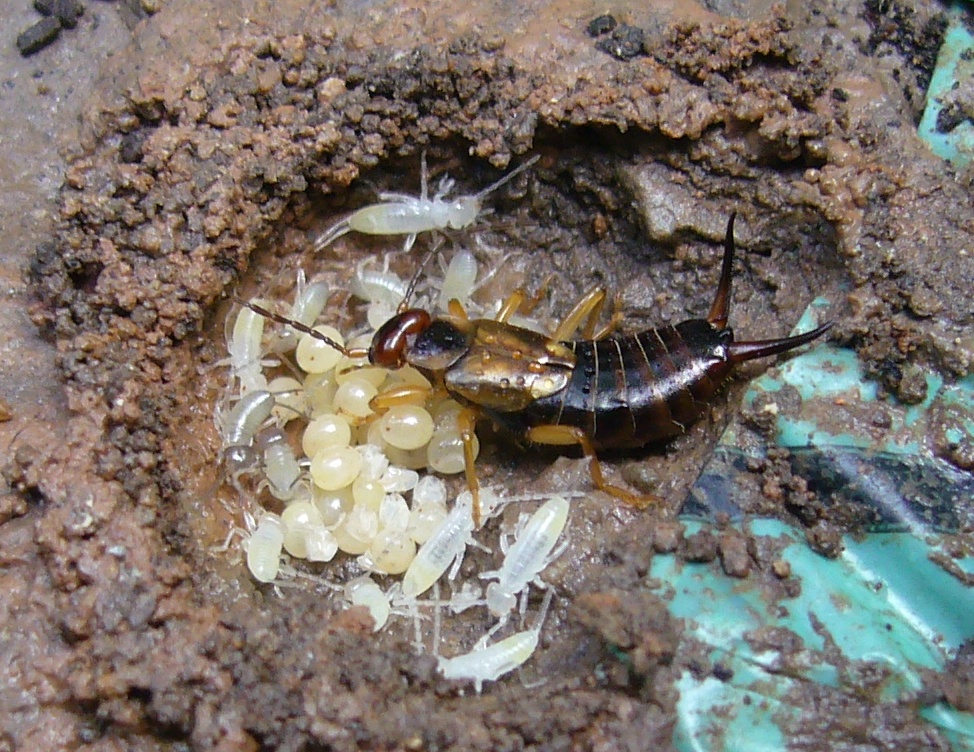
Earwig With Young
Identification Facts
- Young earwigs
- Immature earwigs, called nymphs, resemble smaller versions of adults but continue developing through several stages before reaching maturity.
- Maternal care
- Female earwigs are unusual among many familiar household insects because they provide care for their eggs and newly hatched young.
- Nesting environment
- Eggs and young are kept in protected locations, often in soil or another sheltered space where moisture conditions are suitable.
- Group sightings
- Finding an adult together with eggs or young can indicate that the sheltered location is being used for reproduction rather than simply as temporary cover.
The image above shows a side of earwig behavior that may not be obvious from seeing a single adult. Female earwigs remain with their eggs and young during the early part of development. An earwig found alone under an outdoor object and an adult found with young therefore provide different information about how the location is being used.
Earwig Identification Clues
Earwigs have such a distinctive body structure that a few characteristics considered together can often support a general earwig identification.
- Paired forceps
- Look for two conspicuous appendages projecting from the rear of the abdomen. Their shape can vary, but their position is characteristic of earwigs.
- Elongated body
- The body is relatively long and narrow rather than broad or rounded.
- Long antennae
- Segmented antennae extend prominently from the head.
- Six legs
- Like other insects, adult and immature earwigs have three pairs of legs attached to the thorax.
- Sheltered location
- Earwigs are frequently discovered when damp or protected hiding places are disturbed.
The rear forceps are particularly useful because they distinguish earwigs from many other elongated insects. A photograph showing both the full body and the end of the abdomen usually preserves the most useful visible characteristics for identification.
Where Earwigs Are Found
Earwigs generally favor protected locations where moisture is available. Around Southwest Florida properties, this can place them in landscaping and other sheltered environments close to buildings.
They may be encountered beneath leaves, mulch, plant material, stones, wood, containers, and other objects that provide cover. Their flattened body shape helps them occupy narrow spaces that remain protected from direct sunlight and drying conditions.
Earwigs can also wander indoors. An individual found inside does not by itself establish that earwigs are reproducing within the building. The location of repeated sightings and the presence of suitable moist shelter provide additional context.
Earwig Identification Questions
What are the pincers on the back of an earwig?
The paired structures at the rear of an earwig are forceps-like cerci. They are a normal part of the insect’s anatomy and are one of the most useful characteristics for recognizing an earwig.
Do earwigs use their forceps to sting?
No. Earwigs do not have a stinger at the end of the abdomen. The visible forceps are not a stinging structure. An earwig can use them defensively, but their appearance should not be confused with the stinger of a wasp or similar insect.
Why do I find earwigs underneath things outside?
Covered locations can provide the darkness, shelter, and moisture earwigs favor. Moving mulch, wood, containers, stones, or other outdoor objects may expose earwigs that were concealed beneath them.
Do earwigs care for their young?
Yes. Female earwigs provide maternal care, remaining with their eggs and tending them during development. They may also remain with newly hatched young during their early stages.
Does finding an earwig indoors mean they are reproducing inside?
Not necessarily. Earwigs commonly occupy outdoor sheltered environments and can wander into buildings. Repeated sightings in the same moist or protected location provide more information than finding a single individual indoors.
Can an earwig be identified by its rear forceps?
The paired forceps are one of the strongest clues for recognizing an earwig, particularly when they are considered together with the insect’s elongated body and long antennae. Identifying the exact species may require closer examination and additional characteristics.